"Research becomes much more powerful when information and samples are collected in a consistent way and can be shared across institutions."
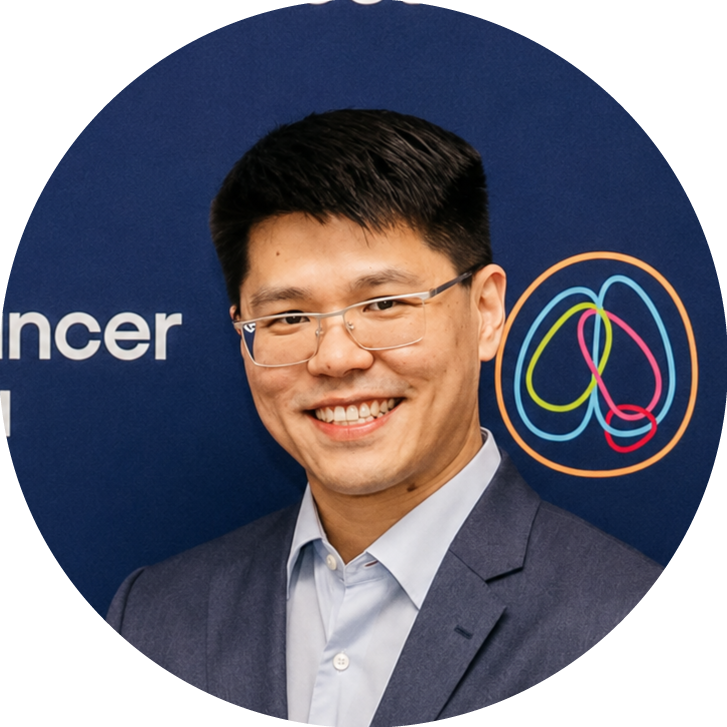
Associate Professor Hao-Wen Sim
To put Australia at the forefront of brain cancer research, Associate Professor Hao-Wen Sim believes we must make the most of every patient experience, every data point and every tissue sample.
A Medical Oncologist at Chris O'Brien Lifehouse and The Kinghorn Cancer Centre, a researcher with the University of Sydney's NHMRC Clinical Trials Centre, and a member of Brain Cancer Australia's National Consortium Steering Commitee, Hao-Wen sees firsthand how connected systems can accelerate research and improve outcomes for patients.
"Research becomes much more powerful when information and samples are collected in a consistent way and can be shared across institutions," he says. "We're a relatively small country, which means we need to work together. You don't want researchers around the country duplicating work because systems aren't connected."
After completing specialist training in Australia and a neuro-oncology fellowship in Canada, Hao-Wen returned home determined to focus on brain cancer.
"Everyone said that brain cancer was too niche and too rare, but we have enough patients and there is a huge unmet need for better treatment options," he says.
"Brain cancer may be less common than many other cancers, but the burden on patients and families is enormous. Many people are in the prime of their lives – building careers, raising families and contributing to society."
Alongside his clinical work, Hao-Wen plays a leading role in brain cancer research.
He believes Brain Cancer Australia's three national research infrastructure platforms – the Australian Brain Cancer Registry, the Opt Me In registry trials and patient enrolment platform and the Biobanking and Organoid Platform – have the potential to transform both patient care and research.
"The Registry will help ensure brain cancer care is consistent across sites and provide the benchmarking needed to identify gaps and improve outcomes," he says.
"But the real potential lies in research. Registry data can help us design more efficient and robust studies, while the biobanking network will maximise the value of every tissue sample and support trials that can take years to conduct."
"Together, these platforms will create opportunities that don't exist today."
Despite the challenges of brain cancer, Hao-Wen remains optimistic about the future. His patients motivate him to keep pushing for progress.
"When I feel exhausted, I just think of the patients I'm seeing this week. They are far more exhausted than me and are facing challenges far greater than anything I experience day to day.”
Read more about Hao-Wen's impact in brain cancer research and patient care.