


Bbetter data is essential to improving care and outcomes for people with brain cancer.”
Professor Lindy Jeffree
Professor Lindy Jeffree presented the Australian Brain Cancer Registry at the 100th anniversary of the Society of British Neurological Surgeons (SBNS 100) last week.
As Chair of the Brain Cancer Australia National Consortium Steering Committee, Lindy leads the Australian Brain Cancer Registry, alongside her appointments as Director of Neurosurgery at Bayside Health (Alfred) and Professor of Surgery at Monash University.
The Registry uses automated data collection from existing state and territory systems to track brain cancer patient treatment and outcomes from diagnosis to end of life. The data is analysed against agreed quality indicators to produce public reports and confidential feedback for hospitals and clinicians, so they can improve care.
“With the lack of effective treatments for brain cancer, best-practice care matters. The Registry is already enabling clinicians and hospitals in Queensland to identify and address variations in care. When it’s rolled out across the rest of Australia, it will bring us closer to a future where every brain cancer patient receives best-practice care – no matter what hospital they walk into,” said Lindy.
In her presentation, Lindy discussed the Registry’s launch with Queensland data, the challenges of its national rollout and the importance of automated data collection.
“We need to move beyond Excel spreadsheets gathering dust in shared drives and build a national clinical quality registry that is sustainable, scalable and can make use of advances such as large language models. But it’s no easy feat,” said Lindy.
"Bringing together data held by different organisations, across state and territory borders, each with its own legislation, policies and approval processes, is hugely challenging. We persevere because better data is essential to improving care and outcomes for people with brain cancer.”
The first Registry report draws on data from Queensland, where the Registry was developed and tested. NSW data will be included in the next report, with work under way to extend the Registry across Australia.
The Registry aims to collect data on over 90% of brain cancer patients, creating the largest and most comprehensive dataset in the history of brain cancer research in Australia.
The Registry is led by Brain Cancer Australia in partnership with Cancer Alliance Queensland (CAQ) and the Australian e-Health Research Centre (AEHRC) at CSIRO. It is funded by the Australian Government’s Medical Research Future Fund (MRFF) Australian Brain Cancer Mission, the Ramsay Hospital Research Foundation and Brain Cancer Australia Charity.
View the ABCR report here: https://www.braincanceraustralia.org.au/our-work/abcr-report
If you would like to learn more or discuss how to get involved, please contact us at info@braincanceraustralia.org.au
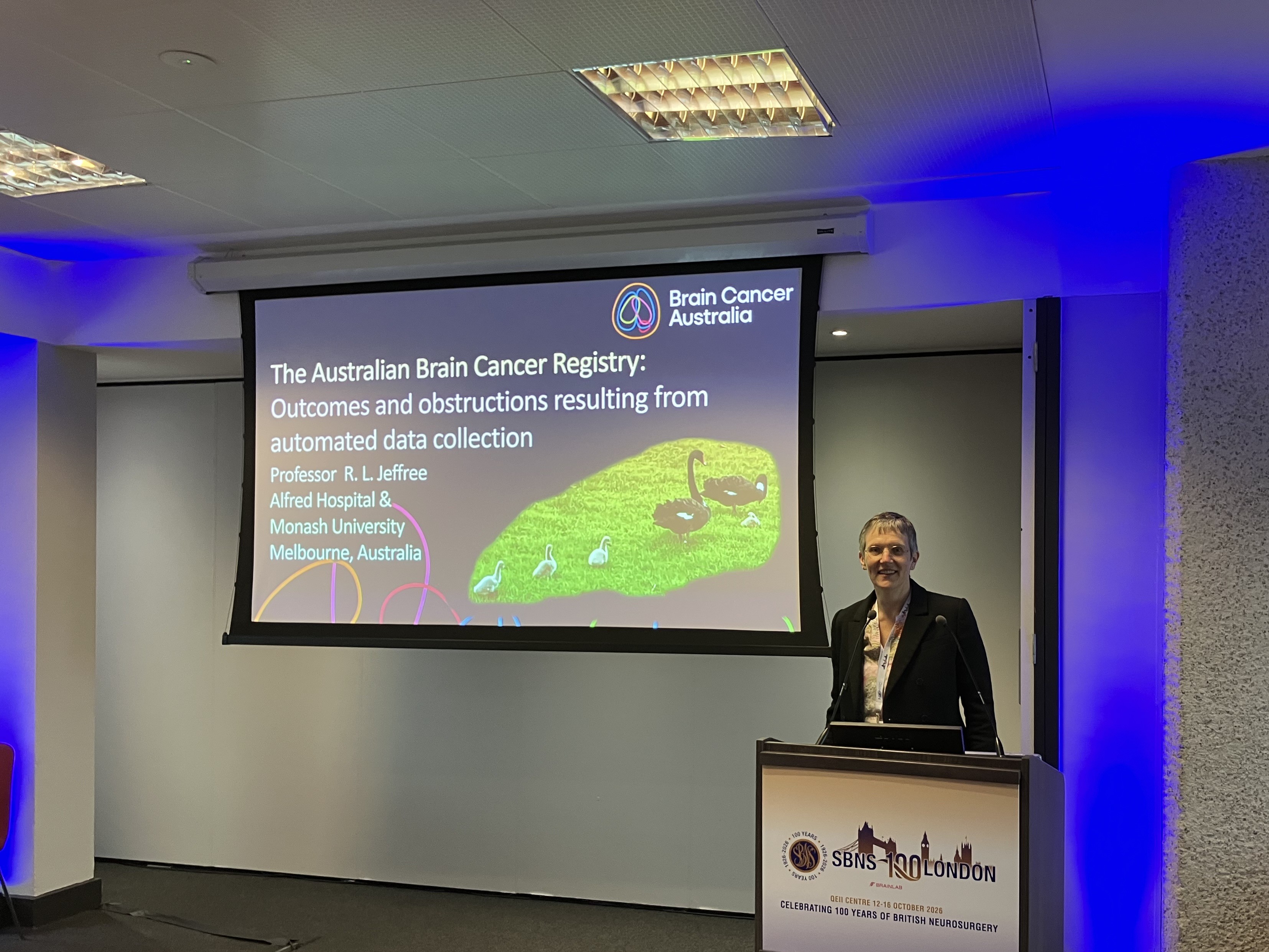
Professor Lindy Jeffee presenting at the at the 100th anniversary of the Society of British Neurological Surgeons (SBNS 100) last week.

